Venezuela Earthquake Death Toll Hits 920 as US Rescue Teams Race Against Survival Window
Venezuela just got hit with one of the worst natural disasters in its modern history — and the situation is still unfolding in real time.
Here's what happened: On Wednesday evening, at around 6:04 p.m. local time, a magnitude 7.2 earthquake struck — and just 39 seconds later, a larger magnitude 7.5 quake followed. The two quakes — centered west of Caracas — rank among the most powerful to hit Venezuela in over 100 years. That back-to-back punch is what seismologists call a "doublet" — two comparable earthquakes that hit the same area nearly simultaneously, and it amplified the destruction massively.
Three days after the earthquakes, the death toll climbed to at least 920, with more than 3,300 injured and tens of thousands still missing. And the numbers have only kept climbing — by Saturday afternoon, the National Assembly president confirmed the death toll had risen to 1,430. The USGS estimates a 44% chance the death toll could ultimately exceed 10,000 people — based on predictive modeling. So the worst may still be ahead.
The hardest-hit area is La Guaira, a coastal state right next to the capital. Interior Minister Diosdado Cabello said roughly 70,000 families there were affected. The International Organization for Migration said up to 6.76 million people in Venezuela could be affected, including some 2 million in Caracas alone.
Now here's the part that makes this even harder to watch: Venezuela was already on its knees before any of this happened. Even before the earthquakes, nearly 8 million people inside Venezuela were already in need of urgent humanitarian support, with public systems overstretched and many struggling to meet basic needs. So there's essentially no safety net to fall back on.
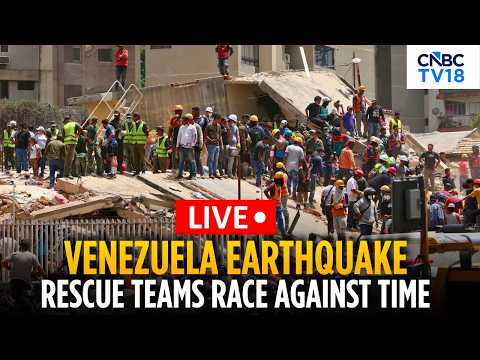
The Venezuelan government's response has been widely criticized. Venezuelans took the search for missing loved ones into their own hands, citing a scarcity of government rescuers — and aid agencies consider the first 48 to 72 hours to be a crucial window to retrieve people alive. Residents reported seeing few state rescue teams in the hardest-hit areas, despite authorities projecting an image of a robust government response.
On the U.S. side, the response has been unusually fast — especially considering the complicated history between Washington and Caracas. American search and rescue teams from Virginia, California, and Florida were dispatched to Venezuela on Friday. The Los Angeles County team alone is 73 strong, bringing concrete-busting machines and listening devices to hear people trapped under rubble. Washington pledged $150 million for disaster relief and sent 250 personnel, including three specialized urban search-and-rescue teams. The U.S. Southern Command also dispatched the amphibious transport ship USS Fort Lauderdale and the littoral combat ship USS Billings to assist.
Rescuers are trying to capitalize on the first 48 to 72 hours after a quake — the "golden" window of time to reach people buried alive. That window is closing, or has already closed for many. Every hour matters.
Why does this matter to you personally? If you have family or friends in Venezuela or the wider Caribbean region, communications are severely disrupted. More than 50,000 names had been entered into an online registry set up by volunteers to help families track down missing loved ones. Beyond the personal connections, this is also a story about whether the U.S. — after gutting foreign aid programs earlier in the year — can still be a credible first responder in a major humanitarian crisis. The world is watching.
Claude’s Scrutiny
The Fox News piece leans heavily on the U.S. rescue response as the heroic frame, but the USGS's own modeling — barely mentioned — suggests the death toll could ultimately top 10,000, which would make the 920 figure in the headline look dramatically understated in hindsight.
Key Takeaways
- Twin 7.2 and 7.5 magnitude earthquakes struck Venezuela 39 seconds apart on June 24 — among the strongest in over a century.
- The death toll was at 920 when Fox News published this piece, but has since climbed to at least 1,430, with tens of thousands still missing.
- American rescue teams from Virginia, California, and Florida were deployed, backed by a $150 million U.S. aid pledge and Navy ships offshore.
- Venezuela's government response has been heavily criticized — locals say they saw almost no state rescuers and had to dig through rubble themselves.
- The country was already in a deep humanitarian crisis before the quakes, with nearly 8 million people in need of urgent support — that pre-existing weakness is making everything worse.
Related videos

Perspectives
-
Centers the U.S. rescue effort as the primary narrative thread, giving prominent placement to American team deployments while framing the Venezuelan government's failures as a backdrop.
-
Most human on the ground — leads with survivor testimonies and scenes of ordinary Venezuelans digging through rubble themselves, emphasizing the gap between official statements and reality.
-
Live-blog format with strong international sourcing; notably the only outlet to highlight that nationals from Brazil, China, Spain, and Portugal are also among the dead.
-
Most alarming on the potential scale — the only outlet to prominently feature the USGS's predictive model estimating a 30% chance the death toll surpasses 100,000.
-
Most analytical piece — specifically interrogates whether the U.S. can deliver effective disaster relief after dismantling USAID, framing this crisis as a direct test of that policy decision.
My Notes
Sloth is free. If it’s useful, you can help keep it running.