Trump's Arlington Cemetery Arch Plan Draws Lawsuit From Vietnam Veterans
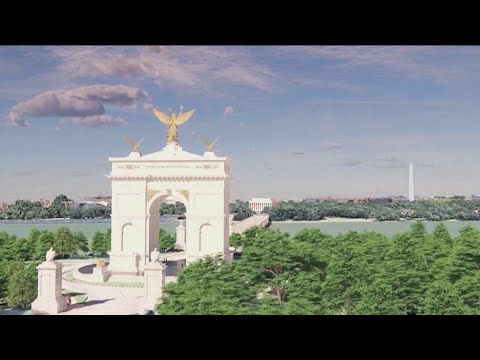
Picture a 250-foot arch — taller than twice the height of the Lincoln Memorial — planted smack in the traffic circle right at the entrance to Arlington National Cemetery. That's what President Trump wants to build, and a group of Vietnam War veterans is now in federal court trying to stop it.
Three vets — Michael Lemmon, Shaun Byrnes, and Jon Gundersen — along with an architectural historian named Calder Loth filed the lawsuit back in February. They're represented by Public Citizen, a progressive consumer advocacy nonprofit. The suit names Trump, senior White House officials, and the National Park Service as defendants.
So what exactly is the beef? A few things. First and most legally significant: the plaintiffs argue the project can't proceed without an act of Congress. The case hinges on two federal statutes — the Commemorative Works Act and part of Title 40 of the U.S. Code — which require congressional authorization for any new memorial or monument on federal land in Washington, D.C. Trump has brushed that off, saying publicly, 'We don't need anything from Congress.' Courts will decide if that's true.
Second, the veterans say the arch would physically and symbolically desecrate a view that matters deeply — the sightline running from the Lincoln Memorial straight through to Arlington House on the hill above the cemetery. That axis was deliberately designed after the Civil War to represent national unity and reconciliation. If the arch goes up, that view is gone. Critics, including the plaintiffs, call the whole thing a 'vanity project.' When a CBS journalist asked Trump who the monument was meant to honor, he answered simply: 'Me.'
Third, there are safety concerns. The plaintiffs argue a structure that size near Reagan National Airport may need FAA review and could pose a hazard to air travel.
The structure — called the 'Independence Arch' by the White House and 'Arc de Trump' by critics — would sit at Memorial Circle, the roundabout next to Arlington Memorial Bridge. At 250 feet, it would be the largest triumphal arch in the world, surpassing the Arc de Triomphe in Paris. The White House calls it a celebration of America's 250th anniversary and says it will 'enhance the visitor experience at Arlington National Cemetery.'
Here's where things stand: The project has been slowly crawling through federal review. The National Capital Planning Commission voted 9-1 to advance the proposal to the next stage of consideration, though it also asked for more information on everything from pedestrian safety to aviation impact. The Commission on Fine Arts also cleared a prior hurdle. But the lawsuit is still live, and a group of House Democrats has separately said they plan to introduce legislation to stop the arch outright.
For you, this matters even if you've never been to D.C. Arlington National Cemetery is one of the country's most sacred public spaces — 400,000 service members and their families are buried there. The debate over this arch is really a debate about who gets to reshape America's most symbolic landscapes, how fast, and whether any checks on that power still apply.
Claude’s Scrutiny
The story leans heavily on the veterans' perspective — which is compelling — but barely surfaces the White House's substantive case for the arch beyond a single PR quote; readers deserve more than one side's framing when a legal dispute is still very much live.
Key Takeaways
- Three Vietnam War veterans sued the Trump administration in February to block a proposed 250-foot triumphal arch at Memorial Circle, just outside Arlington National Cemetery's main entrance.
- The core legal argument: federal law requires congressional approval for any new monument on D.C. federal land — approval Trump says he doesn't need and hasn't sought.
- At 250 feet (more than twice the height of the Lincoln Memorial), the arch would destroy a sightline between the Lincoln Memorial and Arlington House that was intentionally designed after the Civil War to symbolize national unity.
- When asked by a journalist who the monument honors, Trump answered: 'Me' — a quote the plaintiffs cite as evidence it's a personal vanity project, not a national memorial.
- The project is still moving through federal review — clearing two agency votes — but faces the lawsuit, Democratic legislative opposition, and near-unanimous public comment against it.
Related videos

Perspectives
-
The primary source — centers the story on the human experience of the veteran plaintiffs, with on-the-ground reporting at the cemetery site; gives the most space to the veterans' personal grievances over the legal mechanics.
-
NPR's original lawsuit filing story — focuses tightly on the legal claims and statutory arguments, and is the most detailed account of what the complaint actually alleges.
-
Frames the veterans' opposition explicitly as non-partisan patriotism, and is the only outlet to explore the veterans' diplomatic backgrounds as context for why they're uniquely alarmed by the 'authoritarian' optics.
-
Most detailed on the specific statutory citations and the Commemorative Works Act argument; drier and more legally focused than other outlets.
-
Local D.C. TV news angle — emphasizes the aviation safety concern near Reagan National Airport more than most national outlets, and notes the FAA review issue.
My Notes
Sloth is free. If it’s useful, you can help keep it running.